| AI agents | Claude Code, Codex, Gemini CLI, Cursor or a local model run governed ML sessions on your own access; MCP with interactive panels | No built-in agent; GPT summaries of datasets and experiments (off by default); H2O's separate h2oGPTe agents can run experiments once an administrator connects them | Platform to host your company's agents; a data science agent, mainly for data preparation; open-source skills and an MCP server for coding agents | Its own building agent (Cobuild), Claude Code and Codex in its Code Studios, agent hub |
| Price | Free, including commercial use | Commercial licence; demo or trial on request | Commercial, no public price; 30-day trial | Commercial, no public price; free on-premises edition; 14-day cloud trial |
| Interpretation | The full standard set with ICE and ALE, plus archetypes, rules with Train and Test results, trust summary | SHAP, K-LIME, PDP, ICE, surrogate tree, disparate impact; ALE only as a custom explainer recipe | SHAP, XEMP, feature impact, partial dependence, fairness; ICE in a code accelerator; ALE not found in public docs | SHAP and ICE-based row explanations, partial dependence, error tree, subpopulations, counterfactuals, fairness; ALE not found in public docs |
| Model documentation | AutoDoc model card for every kind of experiment, written from the run's recorded evidence: up to 17 sections, from data quality and feature engineering to drift, limitations, monitoring plan and sign-off, with the workspace's intended use, and the model's risk level and approver from its release record. Mapped to the EU AI Act, SR 11-7, PRA SS1/23 and NIST AI RMF, with a list of the evidence still missing. PDF, Word, HTML or Markdown | AutoDoc | Compliance documentation with a template builder; states SR 11-7 support | Model Document Generator (Word); an EU AI Act readiness solution |
| Data checks | Leakage, no-skill floor and a signal check before training (TabICL; Chronos for forecasts); mislabelled-row review; column meanings such as email, phone, address and IP suggested for you to accept | Leakage detection, on by default | Target-leakage and data-quality checks | Column meanings such as email, IP, URL and country; after training, leakage warnings and a check against a dummy model |
| Ranking | Learning to rank | Not found in public docs | Not found in public docs | Not found in public docs |
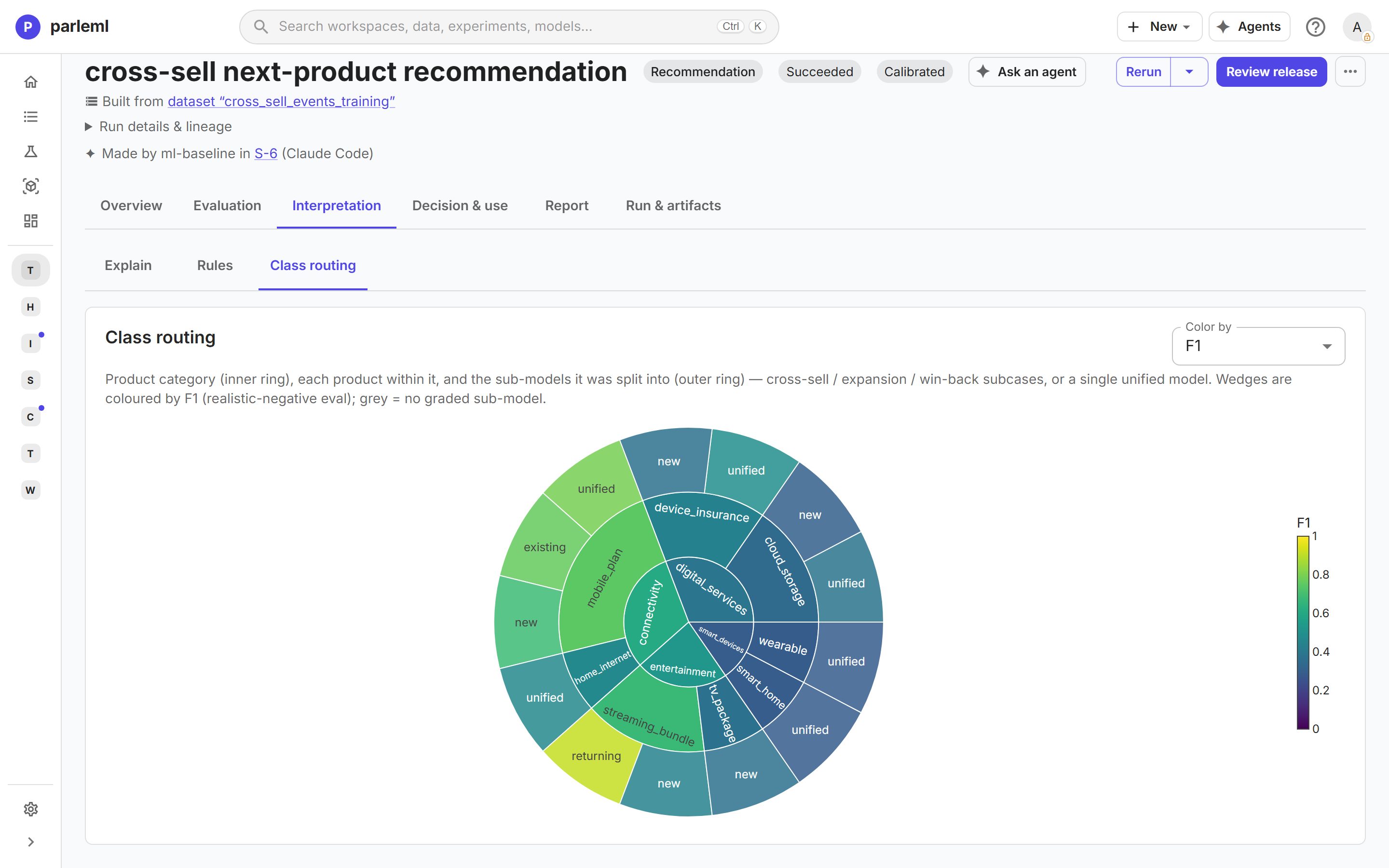
| Recommendation | Calibrated next best product | Not found in public docs | Recommendation engine as a code accelerator (multilabel model) | SQL collaborative-filtering plugin |
| Basket rules | Built in, tested on held-out baskets | Not found in public docs | Not found in public docs | Packaged industry solution |
| Forecasting | Four backends, 28 named models plus AutoGluon's zoo: 19 statistical (AutoARIMA, AutoETS, AutoTheta, AutoCES, MFLES, TBATS, MSTL, Croston, ADIDA, IMAPA, TSB and baselines), LightGBM, XGBoost and CatBoost on lags, six Chronos-2 and Chronos-Bolt checkpoints, and AutoGluon-TimeSeries (DeepAR, TFT, Toto-2, tabular). Raced per series, with prediction intervals | Lag features on its standard models | ARIMA, ETS, TBATS, Prophet, LSTM, DeepAR, GBMs | AutoARIMA, Prophet, DeepAR, Transformer, MQ-CNN, baselines; XGBoost, random forest and ridge on lags |
| Anomaly detection | 23 detectors (ECOD, COPOD, isolation forest, LOF, one-class SVM, autoencoder, VAE and more), an automatic mode, and the reason each row was flagged | Isolation Forest | Isolation Forest, LOF, one-class SVM, MAD, Mahalanobis, autoencoders | Isolation Forest |
| Feature engineering | Counterparts for nearly all of Driverless AI's, plus domain columns, tag lists, multi-table recipes checked point in time | 50+ transformers | Multi-table feature discovery | Pairwise interactions, encodings; genetic feature generation as a plugin |
| Free text | Four kinds of text column, each with its own encoder; words behind each outcome | TF-IDF, linear model, CNN, GRU, BERT; per-row token explanations | TF-IDF, small transformers, CNN; text explanations | TF-IDF, hashing, sentence or LLM embeddings |
| Glass-box and scorecard models | Points-based weight-of-evidence scorecard, EBM, GLM, RuleFit and monotonic boosters, as templates | Weight-of-evidence transformers, monotonic constraints, GLM, RuleFit, decision tree | GA2M rating tables, Eureqa GAM, RuleFit, monotonic constraints | Linear models, decision tree, monotonic constraints on CatBoost; credit scoring as a packaged solution |
| Identifiers | Card numbers, IBANs, phone numbers, emails, names and IP addresses pseudonymised before any model sees them | Not found in public docs | Personal-data detection that flags columns to leave out (preview, self-managed installs); pseudonymisation not found in public docs | Not found in public docs for tabular models |
| Release sign-off | A release record with the approval, an independent challenge, conditions and limitations | Not found in public docs | Deployment approval policies an administrator sets up, with a log of policy events | Sign-off in Govern, a separate node not in every licence |
| Clustering | Seven: k-means, mini-batch k-means, DBSCAN, HDBSCAN, Gaussian mixture, agglomerative, BIRCH. Cluster count chosen for you; clusters named and explained | K-Means (experimental) | K-Means, Gaussian mixture, HDBSCAN; separate licence | Eight clustering algorithms |
| Models | 15 model variants: LightGBM (5 modes), CatBoost (3), XGBoost (2), random forest, extra trees, linear and two neural nets. Plus glass-box EBM, GLM, RuleFit and scorecard, and the TabICL foundation model. Stacked or deeply tuned ensembles | XGBoost, LightGBM, CatBoost, random forest, GLM, decision tree, RuleFit, FTRL, zero-inflated, TensorFlow and PyTorch models (including BERT and GrowNet) | GBMs, GLM, GAM rating tables, Keras, Eureqa, RuleFit, SVM, KNN | Linear, forests, LightGBM, XGBoost, CatBoost, TabICL, neural nets, SVM, KNN |
| Classification and regression | Yes, with calibration, thresholds, business value and class-imbalance treatment chosen by search | Yes | Yes | Yes |
| Regression prediction intervals | On by default: conformal intervals, by quantile regression where it fits, so the width adapts per row, at 80% and 95%, flagged when the coverage can't be trusted | Empirical intervals from holdout predictions | Built in for time series; for other regression, a conformal method in a code accelerator | A helper model fitted on the residuals, 95% by default |
| Production | Python scoring package that refuses to load in an incompatible version, REST scoring, MLflow including Unity Catalog, Treelite | Python, Java and C++ scoring | Deployment, monitoring, approvals | Deployment, monitoring, Govern |
| Images | No | Yes | Yes | Yes |